
The water that I will give will become in them a spring of water gushing up to eternal life.

From a sermon delivered at Grace Episcopal, Sheboygan, Wisconsin | March 8, 2026
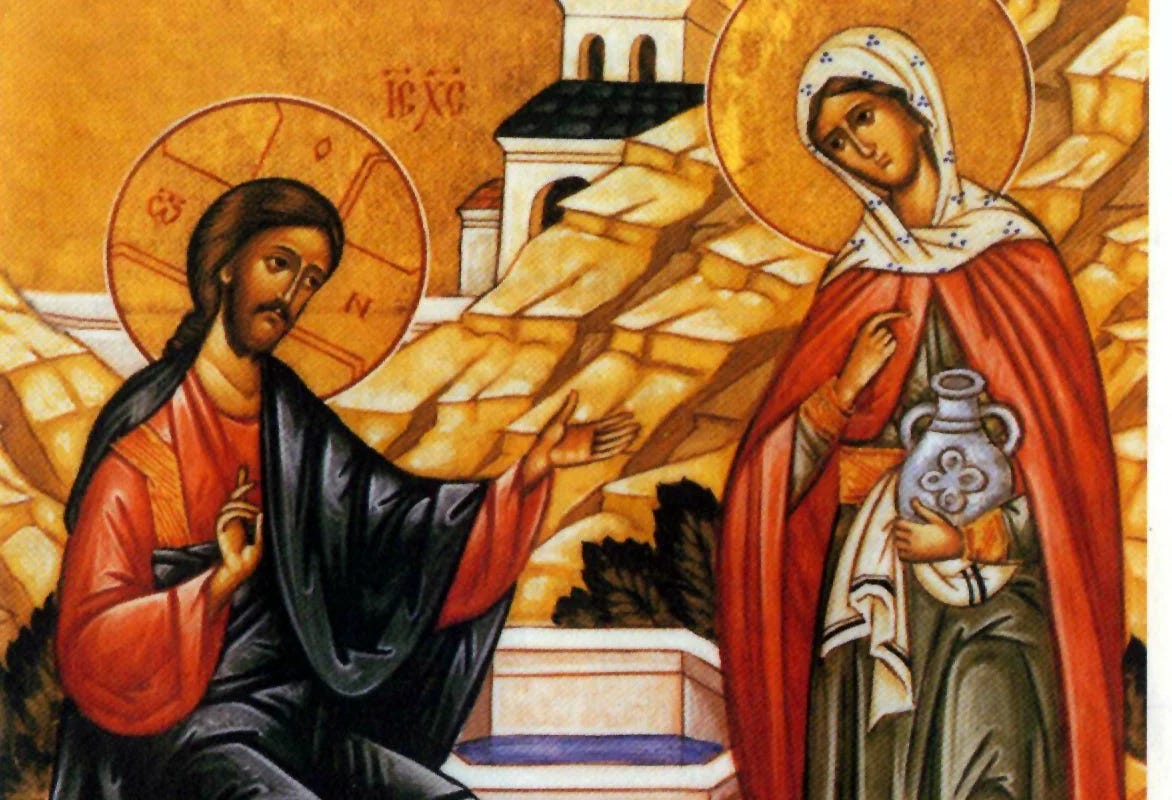
In the Gospel reading this morning, we see Jesus interacting with a Samaritan woman. The woman arrives at noon. Now this is very unusual as most would come to draw water in the morning or evening when the temperatures are cooler. It was also a time of socializing and sharing. The woman coming alone suggests she is socially isolated, avoiding others, or maybe carrying some shame. She is living out her “water jar” of burdens. But there she encounters Jesus. What an unusual place to rest from a journey for Jesus, as it likely was not the most shaded place and there would be far better places to rest.
Jesus asks her for a drink of water. We see the response, “How is it that you, a Jew, ask a drink of me, a woman of Samaria?” We need to understand some context here. This is unusual for so many reasons. The Jews and the Samaritans have a long tense history. It began with the Assyrian conquest in 722BC of northern Israel. After this, the northern Israelites began to marry and have children with the Assyrians. The southern Israelites viewed this as unclean and thus the Samaritans were considered false Jews. The Samaritans rejected the Temple in Jerusalem and in fact had their own Temple at Mount Gerizim. The tension escalated to a point in 128BC with southern Israel destroying the Mount Gerizim temple. The relationship to say the least was very tense. So for Jesus (a Jew) to be talking to a Samaritan woman was very unusual.
But Jesus replies in verse 10, “If you knew the gift of God, and who it is that is saying to you, ‘Give me a drink,’ you would have asked him, and he would have given you living water.” The woman responds, “Where do you get that living water? ” The woman is very confused since Jesus has no bucket and the well is deep. But Jesus wasn’t talking about water you drink. He was referring to the Holy Spirit and the gift of eternal “water”.
Here is where things begin to get interesting. She asks for the “water” that Jesus offers. He asks her to go and get her husband. But she replies she has no husband. Jesus is wanting her to acknowledge her burdens, before explaining that he already knows. God knows every aspect of us and already knows our sins and burdens. He is just wanting us to confess them and acknowledge them. It is when this occurs that the Samaritan woman begins to see who Jesus really is. However, Jesus doesn’t just end there.
He goes on to explain that a time will come, when people are no longer tied to a specific location or group, but that all people will be able to worship God in spirit and truth. Her eyes are opened to who Jesus really is. She races back to the village to tell the others. But what does she not take back with her? Her water jar… her burdens. She leaves it with Jesus. Her burden becomes much lighter.
Like the Samaritan woman, we all have our “water jars”, the sins and burdens we carry with us in the isolation of the noon day where others can’t see. We are ashamed of them. We are drinking the water that makes us thirsty again. We keep trying to find that “one thing” that makes us whole. Chasing this and that, hoping for something that makes us complete. But God already knows about our burdens. He’s fully aware of them and yet… still loves us as we are and wants us to drink the water of eternal life. He wants us to set them down and worship Him in spirit and truth. Think about your own burdens right now. Are they painful to bear? Are they overwhelming and a struggle to carry? God already knows about them and yet, fully loves you more than you can imagine. Thats the message of the Gospel and Lent. A God that loves us so much that He accepts us where we are at now. With all of our baggage, burdens, and shortcomings. But He doesn’t want to leave us “where we are”. He wants to fill us with the Holy Spirit and give us “true” wholeness. As the collect this morning begins, “Almighty God, you know that we have no power in ourselves to help ourselves….”
This morning as we approach the altar for the Eucharist, bring those “water jars’ with you and place them on the altar. God is already fully aware. There’s nothing we can hide. He just wants you to set them down and follow Him. Accept His living water and never thirst again. Do it today and finally feel the load lifted.