
What Actually Forms Us?
The quiet practices that shape a life with God

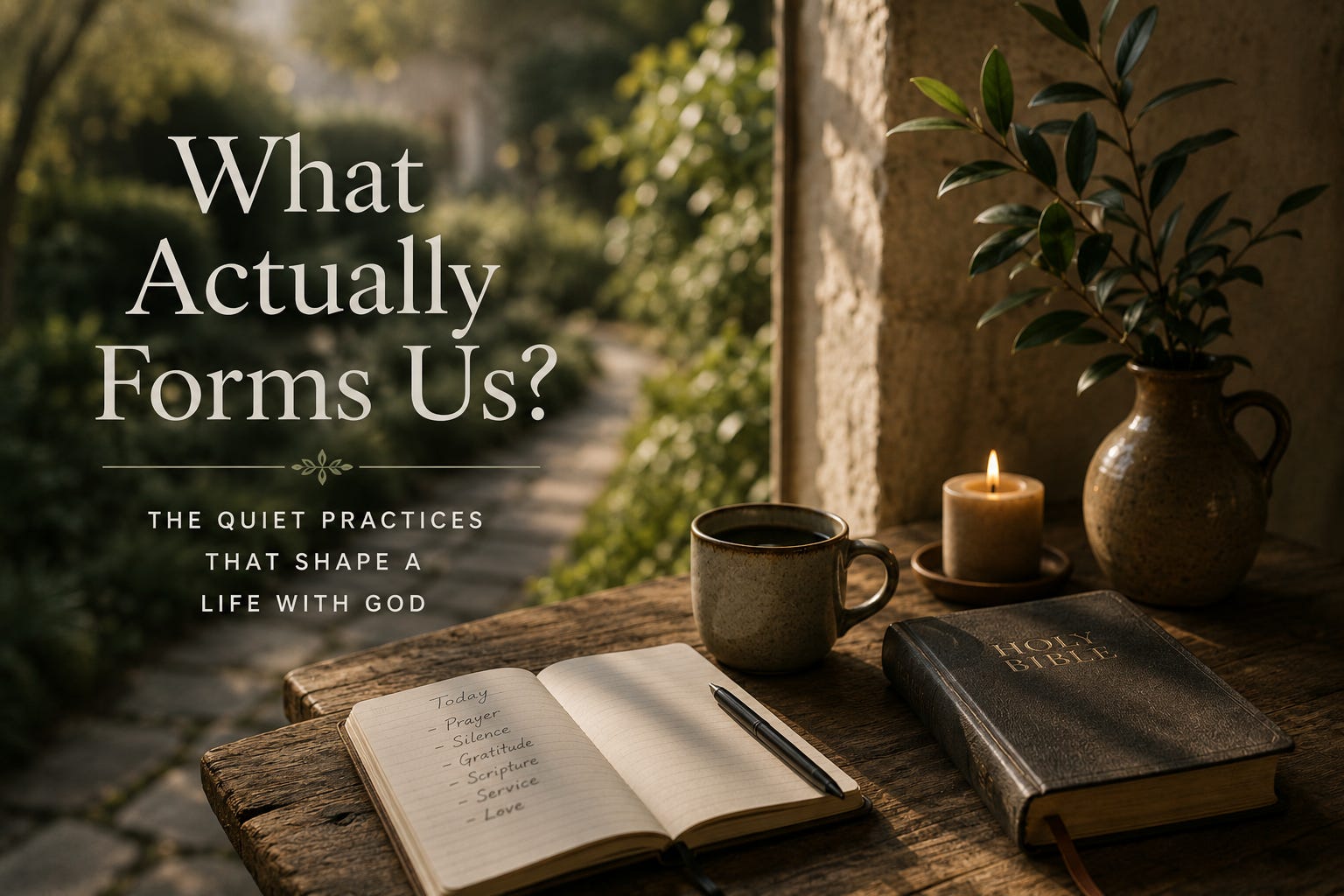
In my last article, I suggested that formation is not the same as education. Education gives us information. Formation shapes a person. That naturally raises another question:
What actually forms us?
If formation is more than classes, books, workshops, and training programs, then how does spiritual growth happen?
The answer is both simpler and more challenging than we might expect.
We are formed by what we repeatedly give ourselves to. Not by our intentions. Not by our aspirations. Not even by our beliefs alone. We are formed by our practices. The Desert Fathers and Mothers understood this centuries ago. They knew that spiritual growth was not primarily about acquiring more knowledge. It was about learning a way of life. A person became holy not because they mastered a body of information but because they slowly learned to orient their life toward God. The same remains true today. Most of us can point to moments that have shaped us deeply. Rarely are those moments classroom experiences. More often they involve prayer, loss, relationships, service, failure, forgiveness, waiting, or love. In other words, life itself becomes the classroom of the soul.
Prayer Forms Us
Many people approach prayer as a tool for getting answers. I suspect prayer is often doing something far more important. Prayer forms our attention. In prayer we learn to become present. We learn to listen. We learn to release our need to control outcomes. We learn to trust that God is at work even when we cannot see it. Over time, prayer changes the one who prays. Not always dramatically. Usually quite slowly. Like water shaping stone.
Silence Forms Us
We live in a culture that rarely leaves room for silence. The moment a quiet space appears, we reach for a phone, a podcast, a news feed, or another distraction. Silence can feel uncomfortable because it removes our usual escape routes. Yet silence is often where we begin to encounter ourselves honestly before God. In silence we discover what we have been avoiding. We become aware of our fears, attachments, anxieties, and desires. But we also discover something else. We discover that God is present beneath all the noise.
Community Forms Us
Despite our desire for independence, none of us is formed alone. The people around us shape us more than we realize. They reveal our blind spots. They challenge our assumptions. They invite us into greater compassion and patience. Christian formation has always been communal. Not because community is easy, but because it is difficult. Learning to love real people is one of the primary ways God shapes us.
Service Forms Us
Service has a way of disrupting our self-centeredness. When we accompany someone who is suffering, feed someone who is hungry, sit beside someone who is grieving, or simply offer our presence to another person, something changes within us. We begin to see the world differently. We discover that spiritual growth is not merely an inward journey. It is also an outward movement toward others. Love becomes embodied.
Suffering Forms Us
This may be the hardest truth of all. Few of us would choose suffering as a spiritual practice. Yet many of the deepest lessons of the spiritual life emerge through seasons of loss, uncertainty, disappointment, and waiting. Suffering strips away illusions. It reveals what we truly trust. It teaches us humility. It deepens compassion. And if we allow it, it can draw us more deeply into dependence upon God. This does not mean suffering is good. It means God is able to work within even the most difficult circumstances of our lives.
Ordinary Faithfulness Forms Us
Perhaps the greatest surprise is that formation rarely happens through extraordinary experiences. We tend to imagine spiritual growth occurring during retreats, pilgrimages, conferences, or mountaintop moments. Those experiences have value. But most formation happens on ordinary Tuesdays. It happens when we pray even when we do not feel like praying. When we forgive. When we listen. When we choose kindness. When we remain faithful during seasons of uncertainty. When we return to God again and again. The spiritual life is built through thousands of small acts of attention.
Becoming
Formation is ultimately about becoming. Not becoming more religious. Not becoming more knowledgeable. Not becoming more impressive. But becoming more fully alive in God. Becoming more compassionate… more attentive… more loving… more free.
The good news is that formation is already happening. The question is not whether we are being formed. The question is what is forming us. Every day our habits, relationships, fears, hopes, practices, and commitments are shaping the people we are becoming. The invitation of the spiritual life is to consciously place ourselves where God’s grace can do its work.
Not for a moment.
Not for a season.
But for a lifetime.
Because formation is not an event. It is the slow, sacred work of becoming.